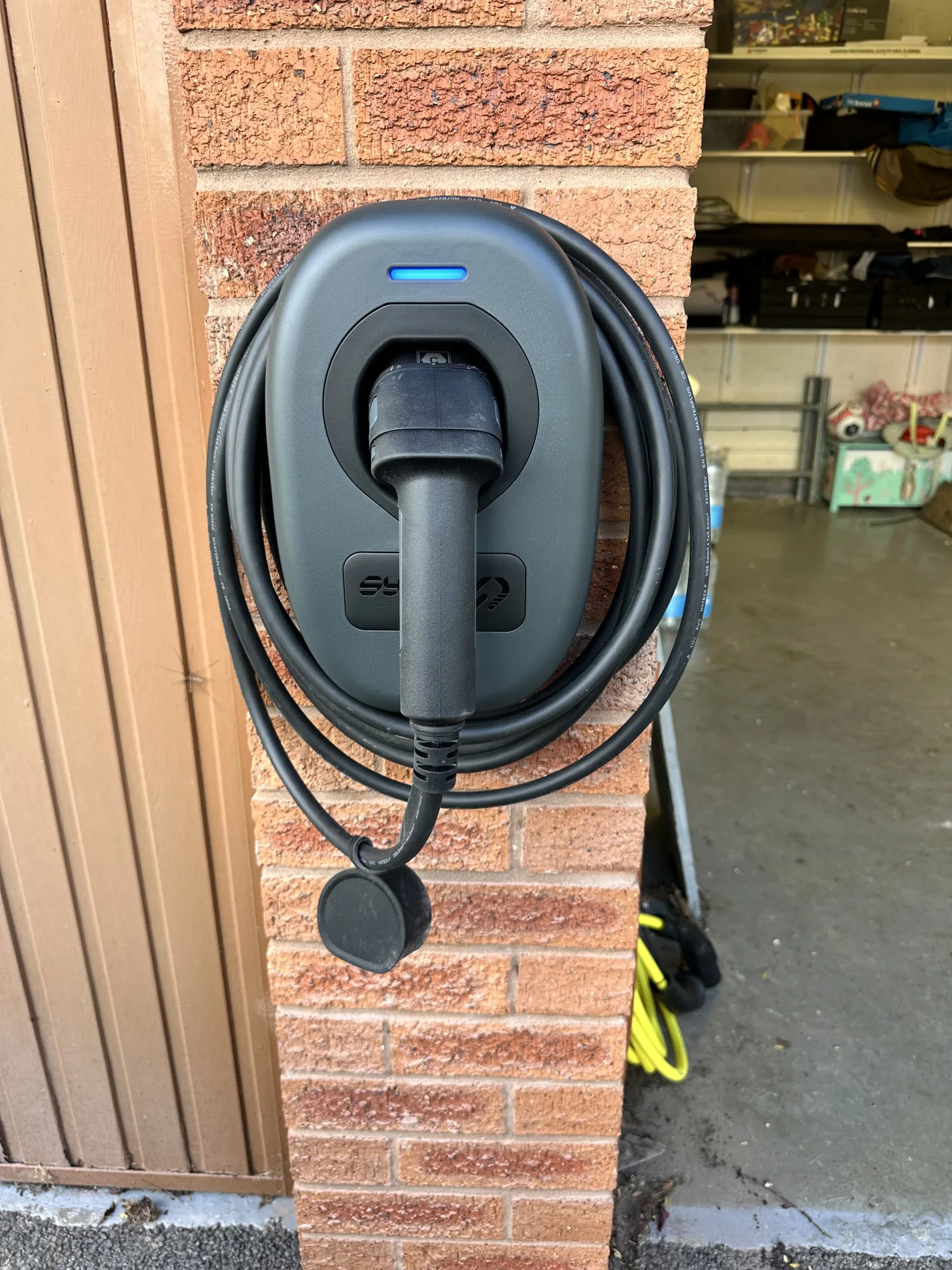
A home EV charger install in Flintshire and North Wales is priced on the charger you choose and the cable run, and takes around half a day. Before fitting, Nathan checks your supply and fuse board; if the board isn't suitable, a dedicated EV consumer unit can often be fitted instead of a full replacement. Many chargers can also work alongside solar PV.
If you have just bought an electric car, or you are thinking about it, the first question is usually where you are going to charge it. Public chargers are handy on a long trip, but for everyday driving nothing beats plugging in on your own drive and waking up to a full battery. A home charge point makes that simple, and the install itself is usually far less disruptive than people expect. Here is how it works when Nathan fits one for you, from the first look at your fuse board to the moment you plug the car in.
Home Charging Basics
A home EV charger is a wall-mounted unit wired back to your consumer unit on its own dedicated circuit. It is designed to deliver a steady, higher-powered charge than a standard three-pin plug, safely and every day, without the cable or socket getting hot.
- Faster than a plug socket: A dedicated charger tops the car up much more quickly than a domestic socket, so an overnight charge covers most people's daily driving with room to spare.
- Built for the job: Charge points have their own protection built in and are fitted on a circuit sized for the load, rather than borrowing an existing socket that was never designed for hours of continuous use.
- Tethered or untethered: A tethered charger has the cable permanently attached, so you just unhook it and plug in. An untethered unit has a socket, and you use your own cable. Tethered is quicker day to day; untethered looks tidier on the wall.
- Smart features: Many chargers connect to an app, so you can see what the car has used, set charging times and make the most of cheaper overnight tariffs.
Checking Your Supply and Fuse Board
Before anything is fitted, we look at what your property already has. An EV charger is one of the biggest loads you can add to a home, so the supply and the consumer unit need to be able to handle it alongside everything else you run.
- Your incoming supply: We check the main fuse and the supply arrangement to make sure there is enough capacity for the charger as well as your cooker, shower and the rest of the house.
- Your fuse board: Older boards may not have a spare way, the right protection or enough room for the new circuit. We check its condition and whether it can safely take the extra load.
- Earthing and bonding: We check the earthing arrangements, because these affect how the charger is set up and protected.
- A dedicated EV consumer unit: If your existing board isn't suitable, it doesn't always mean a full replacement. In many homes a dedicated EV consumer unit can be fitted alongside it, just for the charger. If a full upgrade really is the better option, we will explain why and price it clearly.
This check is also when we talk through where you park, which side the car's charging port is on and where you would like the charger to go.
Choosing the Charger Location and Cable Route
The best position for a charger is the one you will actually find easy to use every day. A few minutes spent planning this saves years of stretching a cable round the car.
- Close to where you park: Ideally the charger sits within easy reach of the car's charging port, without the cable crossing a path where someone could trip over it.
- Wall, pillar or post: Most chargers go on the front or side wall of the house or garage. Where that doesn't work, a brick pillar or a dedicated post can be an option.
- A tidy cable run: We plan the route from the consumer unit to the charger to keep it as short and neat as possible, using the most sensible path through or around the property.
- Thinking ahead: If you are likely to have a second electric car later, or you might change where you park, it is worth mentioning at the start so the position works for the future too.
Thinking About a Home Charger?
Call Nathan on 07842 492371 for a free quote on a home EV charger anywhere across Flintshire, North Wales, Cheshire and the Wirral.
Call for a Free QuoteWhat Happens on Installation Day
A standard home charger install takes around half a day. We aim to fit your charger within a week of your first enquiry, depending on the charger you choose and whether any extra work is needed.
- Power off for a short time: The electricity will need to be switched off while the new circuit is connected. We keep this as short as we can and let you know before it happens.
- Mounting the charger: The unit is fixed securely in the agreed position, and the cable is run along the planned route and clipped or contained neatly.
- Connecting the circuit: The new circuit is connected at the consumer unit, or at a dedicated EV consumer unit if one is being fitted.
- Testing: Everything is installed and tested in line with current wiring regulations before the charger is switched on.
- Setting up: We help you get the charger online and connected to its app if it has one, and make sure you know how to start, stop and schedule a charge.
We work tidily, protect your home and clear up before we leave, so the only sign we have been there is a charger on the wall.
Charging Alongside Solar PV
If you already have solar panels, or you are planning to add them, it is worth mentioning when you get in touch. Many home chargers can be set up to work alongside solar PV, so you can use more of the electricity your panels generate to charge the car instead of exporting it.
How well this works depends on the charger, your solar system and when the car is at home during the day. We will talk through what is possible with your setup and set the charger up to suit it, rather than promising savings that depend on the weather and your driving habits.
Cost and Aftercare
Our home EV charger installs are competitively priced. What you pay depends on a few things.
- The charger itself: Different units have different features, cable options and smart controls, and that affects the price.
- The cable run: A charger on the wall next to the fuse board is quicker to fit than one at the far end of a drive.
- Your fuse board: If a dedicated EV consumer unit or other upgrade is needed, we will include it clearly in your quote so there are no surprises on the day.
Once the charger is in, you will get the test results and paperwork for the installation. Keep these safe, as they are useful for warranty claims and if you ever sell the house. If anything doesn't seem right after the install, or you have a question about using the app, just call or message Nathan directly. You can read more about the service on our EV charger installation page.
Frequently Asked Questions
A standard install takes around half a day. If a dedicated EV consumer unit or a longer cable run is needed, it can take a little longer, and we will tell you that when we quote.
Not always. We check your existing board first. If it isn't suitable, a dedicated EV consumer unit can often be fitted alongside it for the charger, which is usually simpler than replacing the whole board.
We aim to fit your charger within a week of your enquiry, depending on the charger you choose and whether any extra work is needed.
Many home chargers can be set up to work alongside solar PV so you can use more of your own generated electricity to charge the car. We will check what is possible with your system before recommending a charger.